Bob Kerrey, former Governor of Nebraska and Navy Seal Congressional Medal of Honor winner, was once asked what it takes to win the Medal of Honor. “First, you must do something; someone must witness it, and then someone has to be alive to write about it.” For these reasons, many acts of bravery go unrecorded and unrecognized. Recorded history functions similarly. We only know the history that’s been documented; often, history remains unwritten because people may not realize that their actions are significant or might not care to share what they know. As a result, written history is often either incomplete or, in many cases, recorded later and interpreted by those who did not witness the events themselves. The history presented here is accurately documented based on the experiences of early players and eyewitness frisbee and disc sport pioneers.
Guts History
“Guts players are Frisbee’s rock stars.” – Stork
Beginning in the 1950s, the initial concept for the newly invented flying disc, later known as the “Frisbee,” involved simply throwing it to watch it fly. By the 1960s, instructions to enhance Frisbee play were printed on the back, encouraging players to “PLAY CATCH and EXPERIMENT” with various throwing and catching methods. These were the instructions for what was already the first Frisbee play. The instructions marked the inception of throw and catch “freestyle,” setting the stage for all subsequent disc sports. The first modern disc sport, guts, emerged from the Healy brothers’ informal activity of tossing and catching the innovative flying disc during family picnics in the late 1950s.
One to five team members stand in a line facing the opposing team across the court, with the two teams lined up parallel across from each other. Which team begins the play is determined by “flipping the disc”, an action similar to a coin toss, but using the disc itself. One member of the team is then selected to start play. That member then raises an arm to indicate readiness to throw, at which point the members of the opposing team freeze in position.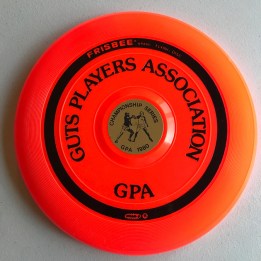
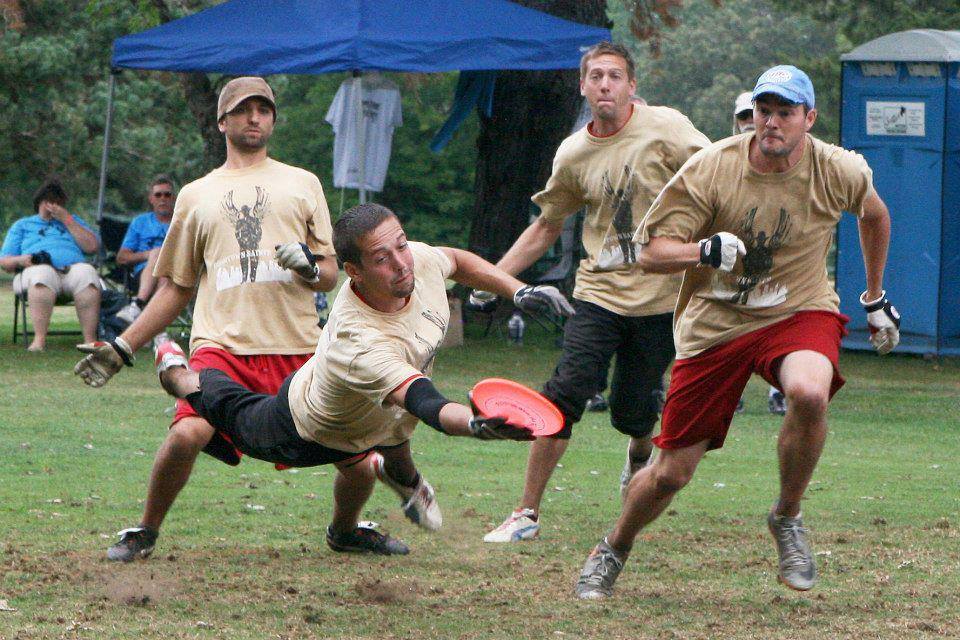
In this game, a player throws a disc with maximum force towards an opposing team member. If the throw misses the designated “scoring area”, the opposing team earns a point. However, if a player from the opposing team catches the disc without issues, no points are awarded to either team. If the throw is within the scoring area but the opposing team drops or fails to catch the disc, the team making the throw earns a point. The receiving team then picks up the disc and becomes the throwing team.
The receiving team must catch the disc cleanly in one hand, and may not move from the position until after the disc leaves the hand of the thrower. The disc may not be trapped between the hand and the body, including the other hand. This frequently results in a challenging sequence of “tips” or “bobbles”, which are rebounds of the disc off the receivers’ hands or body to slow the disc down and keep it in play until it can be caught. This often involves multiple players on the receiving team.
Play continues until at least 21 points have been scored by one of the teams and there is a difference in score of at least 2 points.
IFT History
The first International Frisbee Tournament was held in Eagle Harbor, Michigan, in 1958. The sport originated as a pastime during the Healy family picnics. In the 1960s, specifically, brothers James (Tim), John (Jake), Robert (Boots), & Peter (Beka) — and, in the 1960s, its national profile was increased by Jim Boggio. Sr. As the game of guts developed during that time, players began to throw the discs at increasingly high speeds. It soon became common to see what were thought to be unbreakable discs traveling at speeds of 60 to 70 mph shatter upon impact with an unfortunate defender’s hand. Catching a speeding disc directly was said to really “take guts.”
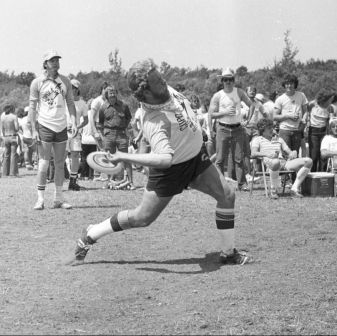
One tournament player even required fifteen stitches to close a gaping wound across the palm of his hand. By the early 1970s, the game had spread across the United States, Canada, and other countries. The Canadian Open Frisbee Championships 1972 presented the second-oldest guts tournament. This multi-event tournament was played in Toronto, at the Canadian National Exhibition C.N.E. and Toronto Islands. In 1985, Ken Westerfield and Peter Turcaj produced Labatt’s World Guts Championships on the Toronto Islands. With over 60 teams at a tournament in the game’s heyday, matches became intensely competitive, seeking the IFT’s Julius T. Nachazel Trophy. With radical curving shots, deflected Frisbees bobbled frantically among teammates, and spectacular diving catches, guts had become an extreme sport demanding fast reflexes, physical endurance, and concentration.
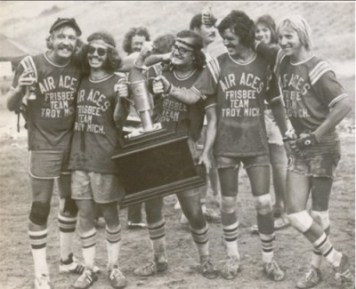
Since its rise in the 1970s, when even ABC’s Wide World of Sports was televising guts action, and many tournaments were springing up, from Toronto to Chicago and Los Angeles, the sport has gradually declined in popularity in America. Guts had been introduced in Asia by the toy company Wham-O in the 1970s, and by the 1990s, it had become even more popular in Japan and Taiwan than in the US. Recent years have seen pockets of strong new American players renewing competitive American interest in the game, drawing some older players out of “retirement”.
Organization: USA Guts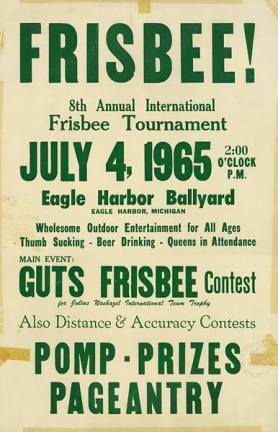
Next Articles:
Home Page: The History of Frisbee and Disc Sports
History of Ultimate Frisbee
Disc Golf History
Freestyle Frisbee History
Note: This information was referenced and time-lined from disc sport historical and biographical articles, including U.S. and Canadian Disc Sports Hall of Fame inductions, Disc Sports Player Federations, and other historical resources. Frisbee and disc sports historians conducted this article’s research, writing, and compilation. The history in this document may change as events and people are added.
Reproduction or linking to this text, in whole or in part, with proper credit is allowed. (discsportshistory.com).
© 2026 Disc Sports History. All rights reserved.
 The History of Frisbee and Disc Sports