
“Every play you make, every call you initiate or counter, reflects your integrity and character as a player and an individual. Regardless of its immediate significance and your desire for it to benefit your team, your actions are observed by all those present. These moments are how you will be judged and remembered by others as to how you played the game, and when under moments of intense game pressure, you measured up.”
Origin of Spirit of the Game.
Numerous articles and speculations have emerged regarding the origin of the Spirit of the Game (SOTG). It’s important to note that, much like the creation of the sport itself, SOTG was not invented or deliberately established; rather, it evolved naturally under unique circumstances, with early alternative disc athletes participating in all disc sports, including ultimate.
“The Spirit of the Game (SOTG) emerged organically in the alternative disc sports community.”
When children first begin to play sports, they typically do so without supervision until they develop the skills needed to participate in a structured sporting environment. This structured progression can include: city leagues, high school teams, college athletics, semi-professional leagues, and professional sports. This informal introduction to sports contrasts with disc sports like ultimate, which initially lacked the traditional structured approach common in ball sports.
In the early 1970s, when ultimate frisbee was introduced to the national disc sports community, ultimate lacked this formal structure. Top alternative disc athletes competed at the highest level in this new sport. They played Ultimate Frisbee purely for fun, with none of the traditional incentives or need for supervision. As the sport grew and became more organized and structured, the decision was made to make the spirit of honest, respectful play, which had already become a standard in all disc sports, a rule in ultimate frisbee. The players themselves decided to make Spirit of the Game permanent on every organized level. Unlike traditional sports, the top athletes in this new disc sport had the unique opportunity to establish their own rules of play.
Freestyle – The Spirit and the First Frisbee-Play.
“Play catch, invent games. To fly, flip away backhanded; flat flip flies straight; tilted flip curves-experiment!” – Wham-O Frisbee.
This is the inscription on the back of all the Frisbees from the mid-1960s. A flying disc for experimenting with different throwing and catching techniques. The first words to define the first Frisbee-play that would later be called freestyle.
“Freestyle is the Mother of all disc sports.”
The roots of modern disc sports can be traced back through the history of freestyle play from the 1950s.
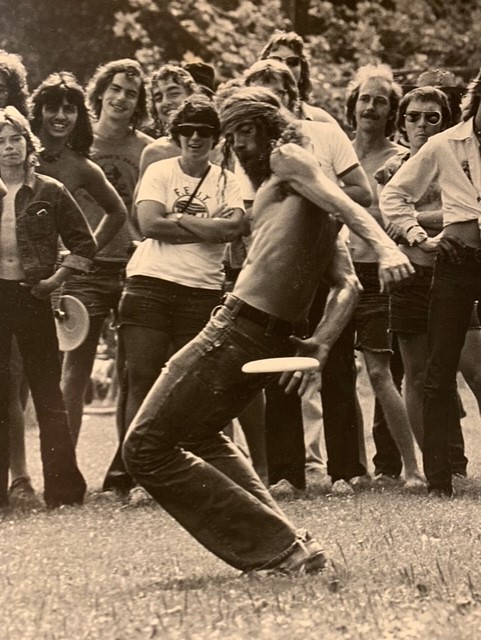
Guts, disc golf, and ultimate originated from similar ball sports formats, replacing the ball with a flying disc. These disc sports provide an enjoyable experience for players of all skill levels. Freestyling requires unique skills and challenges that players set for themselves. Although it was considered the most skillful discipline of disc handling, freestyle did not have to be competitive to be rewarding. The early pioneers of throw-and-catch flow freestyle invented, developed, and introduced the throwing techniques that are used today in all popular disc sports. Initially, disc athletes skilled in freestyle throwing had an advantage when playing ultimate and disc golf. During the 1970s, when Frisbee players played every disc sport, the most proficient disc golfers and ultimate handlers were also the top freestylers.
“As a non-competitive athletic play in the 1960s, freestyle playing with a Frisbee was the perfect activity and athletic alternative for the counterculture.”
Freestyle is one of the few sports that can be rewarding without requiring competition. Accomplishing goals and the satisfaction of personal progress can be its reward. Freestyle, the original disc sport, was a jamming event where players could share their moves and styles with other players. In the 1960s, freestyle, the earliest playing challenge with a flying disc, and the alternative disc athletes of the 1970s helped to create and introduce an early spirit-of-play philosophy that carried over to the first disc sports. It was an unconscious attitude that reflected a period of cultural change.
The Frisbee Family and The Spirit of Play.
“Having referees leads to testing the limits, but when it comes to matters of one’s honor, it becomes a different story.”

Initially, the “flying” appeal of throwing a Frisbee served as the inspiration for every disc sport, rather than a competition. In the early days of Frisbee-play and the beginning of disc sports, the community of disc athletes considered themselves members of a Frisbee Family. The spirit of competition began with these alternative-minded disc athletes and their playing community. This playing spirit, enjoyed by the first skilled disc athletes, was not created but rather uncovered and subsequently characterized.
“The most thrilling aspect of any disc sport is the satisfaction of watching the Frisbee fly exactly as you intended.”
Before the development of freestyle skills and disc sports, individuals enjoyed throwing Frisbees simply for the pleasure of watching them fly. This simple activity served as the groundwork for all disc-related endeavors. In the 1960s, playing frisbee became a non-competitive recreational activity popular in the counterculture. People experimented with various throwing and catching techniques that eventually became known as “freestyle.” This non-competitive play shaped the attitudes of these early disc athletes at the beginning of the first disc sports.
The Alternative Spirit of the Game.
“The times you fail to live up to your convictions will be remembered by you and others more vividly than your successes.”
The influence of alternative athletes on early disc sports is significant. It was the play that inspired early disc athletes, not the win. Being obsessed with winning at any cost wasn’t in their game. The early alternative disc athletes played hard but were never overly aggressive, in play or attitude, especially in team disc sports like ultimate. For yesterday’s and today’s disc athletes, a player’s conduct while competing was, and still is, as important as winning. The Spirit of the Game (SOTG) concept didn’t begin as a rule, but rather a natural evolution for how the first alternative-minded frisbee players competed.
” An ultimate game has many moments to be won or lost. The final score at the end of the game is only one of those moments.”
During a video interview, Willie Herndon asked Joel Silver about the origins and meaning of Spirit of the Game; it was clear from his response that Joel was uncertain. In the early days of CHS ultimate frisbee, the students were neither athletes nor part of the counterculture. In early films, it was evident that the ultimate players at CHS were just learning basic throwing and catching skills. Like children playing recreational sports in the street or parks, they played without referees, not because of a rule, but simply because they didn’t need them.
“Spirit of the Game was not created by Silver and students at Columbia High School. SOTG organically evolved as a favored competitive concept in the early disc sports community.”
The original rules for ultimate, written by Joel Silver and classmates at CHS, make no mention of Spirit of the Game. In fact, their rules did call for the use of referees. “A referee or referees may officiate, and their decision must be final” – CHS Original Ultimate Rules.
In an interview, Silver explained that when he introduced Frisbee as a new school program, “it was counterculture time and meant to be a joke.” They were not athletes promoting a serious new competitive concept; instead, they were playfully showcasing an athletic event using a toy Frisbee. Despite their initial intentions, playing this new field game with a Frisbee was enjoyable and gained popularity over time. As they were not athletes and had a limited perspective on sports competition, Silver and others at CHS naturally included the use of referees in the written rules. Referees were used at the first intercollegiate ultimate frisbee event between Rutgers and Princeton. Rutgers University won the game 29 – 27. The game took place on November 6, 1972, and was attended by 1,000 fans.
In the early 1970s, a version of frisbee football called ultimate frisbee was introduced to the growing disc sports community, establishing a standard for this new throw-and-catch field sport. The Johnny Appleseeds were a group of ultimate frisbee promoters, some of whom participated in the first Rutgers-Princeton game and graduated from Columbia High School. While the Spirit of the Game philosophy was not officially part of the playing rules at Columbia High School, some of the Appleseeds, after graduation, became skilled disc athletes and joined the disc sports community. The Appleseeds, along with alternative disc athletes, continued to promote ultimate frisbee, helping to establish this self-regulating spirit of honorable conduct.

“SOTG is not a hard and fast rule with penalties for non-compliance. It’s a playing philosophy commitment by a player to present and expect a spirit of honesty and mutual respect every time they take to the field.”
For many players, participating in the first disc sports was still primarily about the flying disc. In the 1970s, while the first disc athletes played new disc sports, they demonstrated their skills without resorting to aggressive tactics. For many of these early players, the main goal was not competition or winning. In the world of ultimate frisbee, the idea of the Spirit of the Game was neither clearly defined nor named. It was more significant as a symbol of a different approach to traditional sports competitions. This approach was more closely related to the early alternative disc athletes than to the game itself. In 1978, it was finally officially recognized, named, and added to the Official Rules for Ultimate, and has continued to be an important aspect of the sport. SOTG also includes an Integrity Rule that requires players to call out their own infractions, giving the fouled player the option. Ultimate honors players and teams with Spirit Awards.
1980s-90s – SOTG Growing Pains.
In the late 1980s, Ultimate Frisbee gained more popularity and attracted players who were not part of any counterculture or held alternative views. This sudden influx of new players brought concerns about whether the Spirit of the Game (SOTG) could survive in a more competitive environment. Many players began to question the importance of SOTG in the game. Some were even unsure what it meant. They argued that the Spirit of the Game (SOTG) rule was causing players to hold back and not play to their full winning competitive potential. Some top-level teams did not follow the Spirit of the Game (SOTG) and took advantage of teams whose players did. In the earlier days of ultimate frisbee, many athletes who grew up playing traditional competitive ball sports were taught to take every competitive advantage to win. However, as younger players took over in the 90s, Spirit of the Game (SOTG) became more widely publicized as what made ultimate special. Players and ultimate programs, especially in schools, began to prioritize Spirit of the Game (SOTG) more, leading to its survival and increasing popularity today. What began as an unscripted counterculture influence in the 1960s and 70s has evolved into a crucial aspect of ultimate frisbee. The documentary Flatball- A History of Ultimate highlights the evolution of ultimate and the importance of Spirit of the Game (SOTG) in the sport.
Even though referees are now a part of professional leagues, the Spirit of the Game (SOTG) remains a fundamental aspect of ultimate. The spirit may continue to face challenges in the future as large sums of money and professional careers become involved in the sport.
Additional Reading:
- Instruction -Performance -Training: Ultimate Frisbee Handling Skills Exercise | Ultimate Frisbee Power Huck and Pull | Ultimate United
- Early freestyle throwing techniques and some new throws that could be used in ultimate, Rowan McDonnell’s 80 Ways to Throw a Frisbee.
- Ultimate Players, Organizations, and media sources: USA Ultimate | Ultimate Canada | WFDF | FrisbeeGuru | Ultimate Rob

Next Articles:
History of Ultimate
Disc Golf History
Freestyle Frisbee History
Guts Frisbee History
Home page: The History of Disc Sports
Note: This information was referenced and time-lined from disc sport historical and biographical articles, including U.S. and Canadian Disc Sports Hall of Fame inductions, Disc Sports Player Federations, and other historical resources. The following article was researched, compiled, and written by disc sports historians. The history in this document may change as events and people are added.
Reproduction or linking to this text, in whole or in part, with proper credit is allowed. discsportshistory.com.
© 2026 Disc Sports History. All rights reserved.
 The History of Frisbee and Disc Sports