About the author: Ken Westerfield is an American pioneer in disc sports, renowned for helping to transform the Frisbee from a simple toy into a competitive sport during the 1960s and 1970s. He has been inducted into the Hall of Fame in three major disciplines: Freestyle, Ultimate, and Disc Golf. (More about Ken Westerfield and his career at the end of this article).
This article covers advanced techniques for adding power to your forehand and backhand throws.
The Ultimate Pull.
“Add distance and hang-time to ultimate Frisbee pulls, and additional power for hucking with enhanced throwing technique.”
Good defenses aim to generate blocks and turnovers from every pass. However, poor pulling can give the offense an advantage, allowing them to start their move up the field before the defense has had a chance to set up. This may result in numerous missed opportunities for blocks and turnovers during a single game. In important matches, small details like this can make all the difference. This article offers instructions on two Frisbee pulling techniques, the “360-Whip Forehand Throw” and “360 Backhand Pull,” which can increase the power of ultimate’s two primary huck and pull throws. A strong, accurate pull that floats slowly to the back of the opponent’s end zone is crucial for a solid defense. This gives the defense enough time to set up and control the tempo by marking a receiver before the first pass. With every pass being a potential block and turnover opportunity, there’s no reason why the block shouldn’t be on the first pass. Moreover, having a reputation for a strong huck can affect the defense’s poaching strategies, thus opening up additional passing opportunities for the offense.
The Psychology of the Pull.
“Winning in ultimate is believing that you will win, and then finding ways to deliver that message to the opposing team.”
Winning an ultimate game requires a combination of athleticism, conditioning, handling skills, and confidence. It’s essential to strategically capitalize on every opportunity within the Spirit of the Game. The psychology of the game varies depending on the level of competition. The puller, often regarded as the team’s strongest thrower, sets the rhythm and pace of the game by executing the initial pull at the start of each playing sequence. A weak or inaccurate pull can reflect poorly on the team, while a powerful pull can demonstrate the team’s strength and determination. By starting the game with a strong pull, you can pressure your opponents and show that there will be no easy goals. A consistent and powerful pull can motivate your team, excite the spectators, and help you send your team’s game-winning message.
360-Whip Forehand Pull for More Distance and Float
“Some ultimate team players do not realize the significance of the pull. They take turns without considering their abilities as if it is just a way to start play.”
It is now commonplace for top ultimate players to possess a proficient forehand pass. If you want to develop a powerful forehand for the huck and pull, you can employ a technique known as the “360-whip forehand.” This technique will enhance your arm speed and distance, enabling you to execute successful hucks and pulls. Even when facing unpredictable headwinds, incorporating a 360-degree motion into your forehand will assist you in propelling your pull to the back of your opponent’s end zone. The “360 whip forehand” requires a slightly different release than a standard pass. The visual analogy for this technique is similar to a third baseman scooping up a ground ball and throwing it sidearm to get the runner out at first.
In this 1970s video, Ken Westerfield throws a Wham-O Frisbee (119g) for distance. I also used this same 360-throwing technique for ultimate pulls with a Wham-O 165g and 175g Ultra-Star. This is a Super 8 film, and a little fuzzy, but you can see the full 360-degree arm whip (rotation) before the release and the throw off the left foot. Before being physically marked, the 360-whip forehand can also add power and speed to a fast downfield huck. Don’t dismiss this as just personal preference. Ultimate players who adopt this added forehand technique will make a difference in a game.
360-Whip Forehand Instruction and Practice.
The grip is slightly firmer than a pass. Two fingers together underneath with the thumb on top, pushing hard enough to indent the top of the disc. A tight grip will give you a better wrist snap to hold the hyzer (inside-out) and more disc spin for a slower descent at the end of the pull.
You’ve seen softball pitchers do a similar 360 arm rotation when pitching and how much whip and speed they can generate with that pitch, as opposed to an underhanded pitch. This is the same difference you’ll feel when hucking or pulling with a 360-degree forehand arm rotation. The 360-degree arm rotation is where the additional speed and power are generated.
If you want to add more power to your forehand throw, it’s not too difficult. Start by standing still and rotating your arm 360 degrees with the disc in your hand. Practice this motion by throwing 10-20 Ultra-Stars while staying in one spot. You may notice the disc flipping over with your first few throws. However, after throwing 20 Ultra-Stars, you will begin to hold the hyzer. While it may take practice, you will strengthen your arm and wrist and improve your timing. Repetition and muscle memory are crucial to perfecting your release timing. Begin by focusing on the arm rotation and release, then gradually add in a walk-up. If you start with your right hand, take two steps – one with the right foot, and one to the left. As you release the disc, lean a little to your right to help swing your hip out of the way. This will allow for more release hyzer and more distance. You can add as many steps as you like, but a run-up doesn’t make that much of a difference in the throw. Unless there are extreme wind conditions, you can reach the back of the end zone with good height using a walk-up. However, running up to the line with your team can add to their morale and momentum.
Be cautious with this throw, as it puts significant strain on the shoulder and elbow. To prevent injury, it’s recommended to warm up and stretch the shoulder before attempting this throw during games. It’s also important to keep the shoulder and elbow warm between plays.
“ Since the 1970s, only two Frisbee players have effectively used this 360 forehand technique. Before the invention of today’s beveled-edge golf disc, the two longest distance throws ever recorded using the old rounded rim disc designs that include the Wham-O World Class Models and the Discraft Ultra-Star were Victor Malafronte’s 538 feet and Ken Westerfield’s 552 feet in the 1970s. Both used the run-up and 360-whip forehand techniques described in this article. Both record throws were with a 119gm 40 mold World Class Frisbee.” – Ultiworld.

360 Backhand Power Pull for Distance and Float.
“It’s better to have throwing power and not need it than to need more power and not have it.”
I’ve observed some ultimate teams use defensive strategies when pulling. One such method involves throwing high, steep curves in the hopes that the receiver will drop the disc or that it will land and roll past them. Another technique is to throw a roller out of bounds around the middle of the field, which buys more time for setting up the defense and implementing a double-team sideline press. While these strategies may offer some advantages, they may not be sufficient when the aim is to establish both setup time and maximum defensive field position. In situations like this, it may be beneficial to consider a method that provides greater pull distance while maintaining maximum float. This would involve adding a “360-degree body rotation” before the backhand release, commonly used by top-distance throwers.
For simplicity’s sake, I’ll refer to this technique as a “360 backhand” or just “360” in this article. This technique allows for the disc to be pulled farther with more float.
“There is a reason why a discus thrower does multiple spins before the release.”
If you want to increase the power of your backhand throw for pulling, adding more arm to the throw can be helpful. While the standard backhand that moves across the body is good for passing and hucking, having extra power for pulling can come in handy in situations with strong winds or when you need to throw for more distance and float. In fact, top backhand distance throwers always use a 360 rotation before the release. This technique was introduced in the late 1970s and has been used by overall power event competitors since the 1980s. Adding upper body rotation increases arm speed, translating into more power and an additional 10 to 20 yards of throwing distance. This can help you reach the back of the end zone, overcome headwinds, and add more disc spin for better float. A slow and controlled 360-degree rotation before the pull, adding a short run or walk up to the line, can help you achieve more pulling power.
360 Backhand Video Demonstration.
The individuals featured in these videos perform various 360 techniques, all of which are equally effective. While the videos showcase the use of a golf disc, the grip and release for a 360 backhand throw are the same for an ultimate disc pull.
Developing the 360 Backhand Release.
I’ve never heard anyone complain of having too much throwing power. Except for the players that don’t have it and their excuses for not needing it.”
If you already have the backhand throw down, you’re halfway there to perfecting the 360 technique. The release will remain the same. You’ll just need to add the beginning half of the 360 to maintain accuracy on longer distances. All top-distance throwers have their own variation of the 360 technique before releasing the frisbee. None have been proven to be better than others, so whatever works for you is fine, especially if you’re not trying to throw over 200 yards. As someone who was relied upon for pulls, I found that adding a 360-degree rotation before releasing the frisbee gave me the extra power I needed. It won’t take long to notice a significant improvement immediately.
Power grip is required, all fingers under the disc tightly against the rim with the thumb firmly indenting the top of the disc. If you’re throwing with your right hand, this is a four-step 360 using your right hand as the lead into the rotation. This does not have to be a fast rotation to be effective; make it slow and deliberate. As you get better, your 360 will become smoother.
Once your 360 is perfected, you can walk or run up with as many steps as you like; the last four steps will always be the same. Begin the four-step 360 by stepping with your left foot. Now, as you step with your right foot, move your right arm with the disc forward. As you take the next step with your left foot, forcefully move your right arm backward; this will begin your body’s rotation. As you swing your arm back, move your right foot and leg back in the same direction of the rotation. This will add momentum to your 360 rotation. You will release the disc on the next step with your left foot. Your right arm helps to begin, lead, and guide the body through the 360-degree rotation.
If you struggle with following directions like me, just start with what you think is right and let your athletic ability and ultimate disc skills take over.
Good luck, and long flights.
About the author, according to OpenAI:
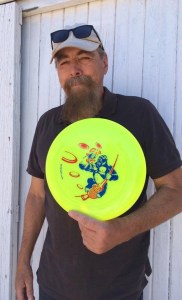
Ken Westerfield, born in Detroit, MI, in 1947, is an American pioneer in disc sports, renowned for helping to transform the Frisbee from a simple toy into a competitive sport during the 1960s and 1970s. He has been inducted into the Hall of Fame in three major disciplines: Freestyle, Ultimate, and Disc Golf.
In 1970, Ken Westerfield and his friend James Kenner designed one of the first object-based disc golf courses at Queen’s Park in Toronto. In 1987, he co-produced the first PDGA World Disc Golf Championships held outside the United States.
In 1971, Westerfield and James Kenner (Discraft founder) became the world’s first full-time professional touring Frisbee players after being hired by Irwin Toy and Molson Brewery. They performed at music festivals, university basketball halftime shows, and for major sponsors such as Molson, Adidas, Labatt’s, Orange Crush, and Air Canada.
Westerfield set several world records, including an impressive 552-foot sidearm throw in 1978, which remains the longest throw for a Wham-O brand Frisbee. This record held until 2014 as the longest sidearm/forehand distance throw for any disc. In 1975, he also established a Maximum Time Aloft (MTA) world record of 15 seconds.
Ken played and promoted Ultimate Frisbee beginning in the early 1970s. Founded the Toronto Ultimate Club (TUC) in 1979, which currently boasts 3,500 members and continues to thrive. In 1987, he won Canada’s first national ultimate championship with his team, Darkside.
Honors: Ken was voted the “Top Men’s Player” for the 1970–1975 Decade Awards. After a 25-year career, in 1987, Ken retired from all involvement in disc sports.
The next article for improving your ultimate playing skills: Ultimate Handling Skills Exercise
Players Organizations, and resources: USA Ultimate | Ultimate Canada | PDGA | WFDF | Freestyle Players Association | FrisbeeGuru | Flying Disc Museum | Ultimate Rob
History articles: History of Disc Sports | History of Ultimate Frisbee
 The History of Frisbee and Disc Sports