
“Ultimate, like disc golf, wasn’t invented; it was discovered.”
Often, recorded history is written by those who were not eyewitnesses, which can lead to the exclusion of actual facts. The story of ultimate disc sport has a rich history beyond the tale of Jared Kass and Joel Silver. Many online resources about this history are incomplete and have not been updated to reflect new discoveries regarding important events and pioneers that have shaped the sport in Canada and the United States.
“Ultimate isn’t just the winning score or how well your team plays, it’s also about your competitive conduct while playing the game.”
Like Tin Lid Golf played by some students in 1926, and before the rise of Frisbee, people played ultimate-like games using metal pans and other flying objects in the early to mid-1900s. In North America, athletes who played ball games played flying disc games recreationally, which they called frisbee football. It was only a matter of time before Ultimate, or a similar game with a different name, would emerge as a popular disc sport. It is easy to imagine, as disc golf and ultimate both share similar competitive playing concepts with well-established ball sports. What distinguishes them is the flying plastic disc, which performs significantly better than a ball or a tin lid. Additionally, the early alternative disc sports community created a spirit of fair play that was integral to all disc sports, including ultimate. History of Ultimate
Freestyle-Play and the Beginning of Modern Disc Sports.
Sports such as guts, disc golf, and ultimate have rules and strategies that closely resemble those of traditional ball sports. All disc sports and early freestyle share a common history. Inscribed on the underside of all the Frisbees since the 1960s, to ‘PLAY CATCH’ and ‘EXPERIMENT’ with different ways of throwing and catching, ‘freestyle’ was Frisbee’s first play.
“Ultimate is a game of passing, consisting of throwing techniques created and developed by early freestylers before modern disc sports.”
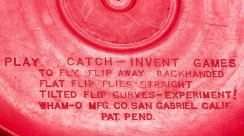
Beginning in the 1950s, the initial concept for the newly invented flying disc involved simply throwing it to watch it fly. By the 1960s, instructions to enhance Frisbee play were inscribed on the back, encouraging players to “PLAY CATCH and EXPERIMENT” with various throwing and catching methods. These instructions marked the inception of the first frisbee play, freestyle, setting the stage for all subsequent disc sports. The first modern disc sport, known as Guts Frisbee, originated from the Healy brothers’ casual activity of tossing and catching the innovative flying disc during family picnics in the late 1950s. Starting in the 1950s, individuals began to explore various techniques for throwing and catching the Frisbee, discovering its potential in sports. Freestyle frisbee, as it was called in the early 1970s, played a crucial role in developing the first generation of skilled disc athletes. The methods created for freestyle throwing have been integrated into all disc sports, including ultimate. When Frisbee football/ultimate was first introduced, it involved backhand passing and two-handed catching. Early freestylers, known for their diverse throwing techniques and catching skills, were among the best ultimate handlers.
Freestyle is one of the few sports that can be rewarding without the need for competition. Accomplishing goals and the satisfaction of personal progress can be their own reward. Freestyle originated as an event where players would share their personal playing techniques and styles with other players. Freestyle, the earliest playing challenge with a flying disc and alternative disc athletes, helped to promote the early spirit of play philosophy in Spirit of the Game to all disc sports.
During the 1970s, the most popular tournament events were freestyle play and freestyle competitions. When players took a break from freestyling, they would engage in other disc sports such as object disc golf and frisbee football/ultimate. Although early ultimate players possessed excellent athleticism, having an entire team skilled in advanced throwing techniques was difficult. Freestylers, who invented and developed all of the advanced throwing techniques used by today’s disc athletes, were the most skilled in all throwing techniques. As a result, they were some of the best overall disc athletes and early excellent ultimate handlers. Their introduction of big throwing techniques made disc sports such as disc golf and ultimate the fun throwing and passing sports they are today.
In 1975, Ultimate’s version of Frisbee football was introduced to the already established disc sports community as an exhibition at the first major disc sports multi-event tournaments. The Octad, New Brunswick, New Jersey, the American Flying Disc Open (AFDO), Rochester, NY, the Canadian Open Frisbee Championships in Toronto and Vancouver BC, and the World Frisbee Championships (WFC), Pasadena, California. Ultimate Frisbee was readily accepted as a new disc sport by the budding disc sports community.
Ultimate Frisbee History in Canada.
“The strongest among the weak is the one who doesn’t forget their weakness.”
In the 1960s and 70s, Frisbee play began in cities and towns across North America. This article highlights the player promoters and their pioneering contributions to disc sports in Canada.
Toronto, Ontario.
Beginning in the 1960s, Ken Westerfield and Jim Kenner played a significant role in introducing disc sports, which included Irwin Toy-sponsored cross-country Frisbee show tours and modern disc sports competitions. The Canadian Open Frisbee Championships (1972-) in Toronto, the Vancouver Open Frisbee Championships (1974-) in Vancouver, BC, and the National Jr Frisbee Program marked the inception of modern disc sports in Canada, including ultimate, disc golf, freestyle, guts, and assorted individual events.
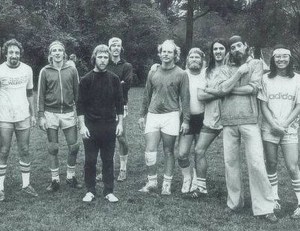
Ken Westerfield and Jim Kenner added ultimate frisbee competitions at their Canadian Open Frisbee Championships on Toronto Island in 1975, and in Stanley Park, Vancouver, BC, in 1977. These were the first ultimate frisbee games played in Canada. In the early competitions, Ken Westerfield participated alongside other disc athletes and ultimate promoters, including some graduates from Columbia High School in New Jersey, known as Johnny Appleseeds.
In the 1970s, Ken played Ultimate Frisbee in the United States, participating on a touring team in the Northern California Ultimate Frisbee League (NCUFL) from 1977 to 1978.
In 1978, Jim Kenner and Gail McColl relocated from Toronto to London, Ontario, and began working on establishing a disc manufacturing company called Discraft. Westerfield, retiring from competing in freestyle, disc golf, and overall NAS competitions in the United States, remained in Toronto to organize Frisbee show tours and disc sports competitions in Canada. Due to his passion for ultimate and his desire to play again, Ken initiated Canada’s first ultimate league in Toronto.
Toronto Ultimate Club
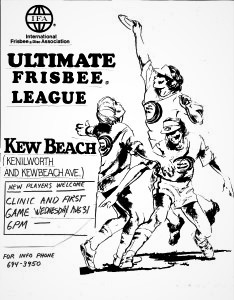
In 1979, Westerfield started an ultimate league in Toronto. Beginning with weekly ultimate pick-up games on Kew Beach with beach freestylers Patrick Chartrand, Stuart Godfrey, Gary Auerbach, and Jim Lim. Chris Lowcock, introduced to disc sports by his brother Les, became part of this group. Ken, Chris, and the others would recruit more players as they passed by on the boardwalk. Weekly ultimate pick-up was becoming very popular. Referencing his player competitor contact list from past tournaments, Ken sent out Toronto Ultimate League invitations to form teams representing Wards Island, West Toronto, North Toronto, and his team, Beaches. These were the first four teams, with teams taking turns hosting weekly league game nights at their respective home locations.
The league’s starting night was at Kew Beach. After almost a decade of early Canadian national Frisbee programs and popular multi-event competitions on the Toronto Islands, Toronto was ready for an ultimate league. The next year, there were six teams, which rapidly expanded to ten. Westerfield used Bob Blakely’s office copy machine and mailing facility at Irwin Toy to produce a weekly newsletter that highlighted games, scores for each team, and the league standings throughout the regular playing season. Chris Lowcock took on management and scheduling responsibilities. Ken and Chris developed the Toronto Ultimate League/Club as it grew substantially. In 1987, Ken Westerfield retired from his 25-year career in disc sports, and Chris continued as president of the TUC until 1991. Furthermore, Chris hosted the 1991 World Ultimate Club Championships in Toronto.
The Toronto Ultimate League, now known as the Toronto Ultimate Club (TUC), currently boasts 3300 active members and over 250 teams playing throughout the year. Being the first ultimate league in Canada, it is also one of the world’s oldest leagues. Ken Westerfield and Chris Lowcock were inducted into the Toronto Ultimate Club Hall of Fame and the Ultimate Canada Hall of Fame as part of the inaugural class.


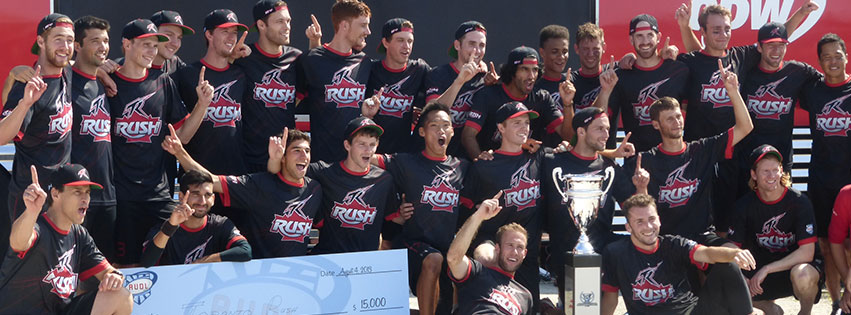
The Toronto Ultimate Club was a founding partner for the Toronto Rush, the first Canadian professional ultimate team in the American Ultimate Disc League (AUDL). The success and impact of the Toronto Ultimate Club (TUC), as a premier organization for ultimate in Canada since 1979, has never been more evident in Canada and the U.S. than when, in 2013, Canadian players, mostly from theTUC, made up a team called the Toronto Rush and joined the AUDL. Until then, all the AUDL teams were American with U.S. players. With all Canadian players, Toronto Rush won every game in their first season, including the AUDL Championships, and has the best record in AUDL professional ultimate history.
Vancouver and Victoria, British Columbia.
Between 1971 and 1977, Ken Westerfield and Jim Kenner toured for Irwin Toy, Canada’s Wham-O Frisbee manufacturing licensee. They traveled across Canada as Frisbee Professionals, promoting frisbee play and disc sports. They performed at various events, including the Calgary Stampede and the Edmonton Klondike Days. Each year, their tour would end in Vancouver, where they would spend the rest of their summer freestyling on Kitsilano Beach and performing nightly frisbee shows on the streets of Historic Gastown.
In 1974-76, Kenner and Westerfield organized early disc sports competitions on Kitsilano Beach, where Vancouver’s Jim Brown, Bill King, and John Anthony participated in their first frisbee and freestyle competition. The ‘Pep Boys,’ as they were later known on the U.S. and Canadian competitive Frisbee tour circuit, became a top competitive freestyle team and played a crucial role in the development of disc sports in Vancouver.
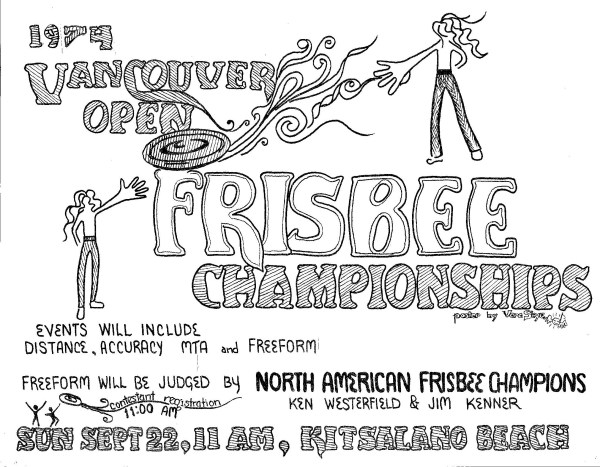 In 1977, Westerfield and Kenner organized and presented the Wham-O/Irwin-sponsored NAS Vancouver Open Frisbee Championships. The event gathered the world’s finest disc throwers to compete in Stanley Park. This meeting of world-level Frisbee players also brought the first official game of ultimate Frisbee to Canada’s West Coast. Along with frisbee street shows and publicity, Vancouver tournaments played a significant role in setting the foundation for organized disc sports on the West Coast of Canada.
Scott Lewis began organizing disc sports in BC, promoting a game called frisbee football, playing it regularly from 1974 to 1976 at Willows Beach in Victoria. He then became involved in running overall tournaments and creating disc golf courses in Victoria, culminating in 1982 when he founded the University of Victoria Disc Sports Club.
After being exposed to the sport while competing in overall tournaments in California, Scott started the first ultimate team in BC, the Flying Islanders. “To put it simply, Scott devoted an enormous amount of time and energy to the development of disc sports and ultimate in British Columbia.” – Ultimate Canada Hall of Fame. 1982 saw the beginning of regular weekly pickup games at Kitsilano Beach in Vancouver. In 1984, the Flying Islanders made the first road trip in BC history, traveling to Seattle to compete in a tournament.
On the weekend of June 29-30, 1985, Jim Brown organized the first ultimate tournament in western Canada, held at Jericho Beach. It featured two Vancouver teams, plus one each from Victoria and Calgary.
The Vancouver Ultimate League was founded in September 1986. The first meeting was attended by Carlo Giuliano, Myrna Monck, Darryl Grigg, Jennifer Newman, Jo Playfair, Adam Berson, Doug Grant, Jim Brown, and Julia Daley. They gathered to organize a league. Because they didn’t have a reliable turnout for their pickup games, they divided themselves into 3 teams and appointed 3 captains. Captains did the hard work of team recruitment and getting the league started. They were responsible for getting teams on the field for each scheduled game. Darryl was captain of the Fringe, Adam was captain of the Nerf Terf Burners, and Jo Playfair was captain of the Flaming Red Sallies. They were the people who got the league started. Adam “Elvis” Berson, Jim Brown, and Scott Lewis were all inducted into the Ultimate Canada Hall of Fame.
Note: This information is from the Ultimate Canada Hall of Fame and VUL.
Ottawa, Ontario.
Keith Whyte learned about ultimate working in a youth hostel in Namur, Belgium, where the 1982 European Championships were held. He played with the UK team and brought his passion for the game to Ottawa.
He taught the game to a few individuals who later formed the Screaming Yellow Zonkers. Marcus Brady and Brian Guthrie started the Ottawa Summer League (1986), Ottawa Competitive Ultimate, and the No Borders Tournament (1987). Keith Whyte acted as the Tournament Director.
 After Marcus played around with discs at Glebe Collegiate, he went on to start an intramural ultimate program at McGill University. He returned to Ottawa and played pickup before starting the Ottawa Carleton Ultimate League Thing (OCULT) with Brian Guthrie and members of five teams. Brian began playing the game in Kingston and Toronto during the mid to late 1970s. In 1984, he began to play pickup in Riverside Park, befriending Marcus. In 1986, the two went on to organize the first Ottawa summer league with five teams. The first captain’s meeting was held in Brian’s living room. Marcus was the tournament director for the first Canadian Ultimate Championships, held in Ottawa at St Paul’s University in 1987. Marcus Brady and Brian Guthrie were inducted into the Ultimate Canada Hall of Fame.
Note: This information is from OCUA.
Calgary, Alberta.
A pick-up version of ultimate began in Calgary, with Pioneers like Joey Fong and Douglas Grant. They came to organize regular games at Riley Park. Steev Limin helped start Calgary Ultimate in June 1985.
In November of the same year, he helped create an open team called the Cynics, Calgary’s first ultimate team. The Cynics competed in the first Canadian National tournament in 1987 and finished in 2nd place to the Toronto Darkside. They would come back to beat Darkside to win the Nationals in 1988.
Calgary Ultimate took on a more regular and serious dimension thanks to the organizing efforts of Grant Burns (CUHOF, 2011). Burns had learned the sport as a student at Upper Canada College in Toronto, and by 1984, he brought an advanced level of athletic performance to what was then still a relatively casual pick-up affair. Then, thanks to a chance meeting with Rick Collins, Calgary’s loose aggregation of players learned about how serious the sport had become in distant hotbeds. Hosting great tournaments became a Calgary tradition thanks to the Cynics. Their annual classic, the Ho-Down, began in 1987. Like the 1995 nationals also hosted by the Cynics, it became a tourney underpinned by what organizers called the Ultimate Player’s Bill of Rights. These included, for the first time anywhere, lined Class-A fields. Scoreboards, ice, and water are in every field. Tent-based accommodation at the venue itself. Field food, morning coffee, and night-time feasting. Hot tubs at the fields and at the party. Raging bands, top DJs, and beer flowed from the Friday night welcome party through the last ragged point on Sunday.
Founded in 2004, the Calgary Ultimate Association began coordinating the first year-round leagues, annual tournaments, a growing juniors program, and multiple outreach efforts to promote the sport of ultimate frisbee within Calgary and surrounding areas.
Note: This information is from the Ultimate Canada Hall of Fame.
Winnipeg, Manitoba.
Jean-Luc Forest and Mike Jones were the co-founders of the Manitoba Organization of Disc Sports. MODS became the first Canadian Ultimate Organization to incorporate in February of 1988. MODS was also the first to achieve Provincial Sports Organization status. Jean-Luc shared his passion for disc sports with his communities, and during the time of his individual accomplishments, he was first introduced to ultimate in Toronto in the early 80s.
In the Summer of 1987, Jean-Luc and Mike Jones organized a Winnipeg team to attend the first Canadian Ultimate Championships in Ottawa. Knowing this was an invaluable opportunity to bring crucial national tournament exposure to a core of Winnipeg players and, in turn, strengthen the disc sports community in Winnipeg, they built a team. The stage was set for Mike, Jean-Luc, and his brother Pierre’s longstanding vision of galvanizing a disc sports community in Winnipeg.
By the Fall of 1987, Jean-Luc and Mike were determined to create an organization that would support the future of Disc Sports in Manitoba. Jean-Luc and Mike were the principal architects behind the drafting of the constitution, establishing the Manitoba Organization of Disc Sports. MODS’ Winnipeg Ultimate League began as a league of four teams at Assiniboine Park in Winnipeg. These early years of the Winnipeg Ultimate League set in motion a series of tremendous accomplishments and growth.
Note: This information is from MODS.
Discraft Ultra-Star – Official Ultimate Disc. London, Ontario.
“A modest pioneer in a sometimes flamboyant industry, Jim Kenner has proven himself to be a brilliant innovator pursuing flying disc excellence.”
Jim Kenner, a pioneer of all disc sports, began playing Frisbee with Ken Westerfield in Michigan in the 1960s. In the early 1970s, Jim organized disc sports competitions and performed in cross-country Frisbee show tours. As tournament co-directors, Jim and Ken introduced all the disc sports at the Canadian Open Frisbee Championships in Toronto and Vancouver, BC. These two tournaments were among the earliest events on the U.S. and Canadian tournament trail for the first disc athletes, marking the beginning of modern disc sports.
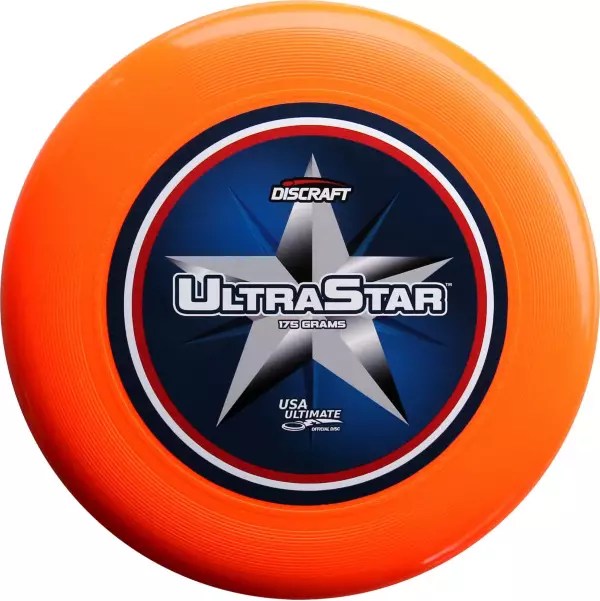 Discraft was founded in 1978 by Jim Kenner and Gail McColl in London, Ontario, Canada. Jim and Gail made a few initial runs of their new Sport Disc, then hosted several disc sports tournaments in London, before relocating the company from Canada to its present location in Wixom, Michigan. Discraft introduced flying discs for every disc sport, including the Ultra-Star 175-gram disc in 1981, with an updated mold in 1983. This disk became the standard for ultimate frisbee during the 1980s. In 1991, the Ultra-Star was specified as the official disc for UPA tournament play.
Gail and Jim have been inducted into the World Disc Golf Hall of Fame and the FPA Freestyle Disc Hall of Fame. In 2011, the Discraft Ultra-Star and Jim Kenner were inducted into the USA Ultimate Hall of Fame for Special Merit.
Elite Canadian Teams
“All it takes is all you’ve got.”
Ultimate Canada, founded in 1993, serves as the governing body of the sport of Ultimate in Canada. It runs the Canadian Ultimate Championships (CUC) and Canadian University Ultimate Championship (CUUC) series.
The first Canadian Ultimate Championships (CUC) for the open division was held in Ottawa in 1987. OCUA hosted the CUC in 1993, 1999, 2002, and 2011.
In 1987, the ultimate team Darkside of Toronto won Canada’s first national ultimate championships in a close final against the Calgary Ultimate Cynics. The Cynics would return to win against Darkside in the 1988 Canadian Ultimate Championships (CUC).

Toronto’s Ultimate Darkside and Hall of Fame Team, Calgary Ultimate Cynics, were Canada’s best men’s teams. Hall of Fame Team See Jane Run from Toronto was Canada’s first Women’s touring team, dominating national championships from the late 1980s.
Ultimate Canada Hall of Fame Teams Furious George and Goo/Prime, based in Vancouver, BC, and Goat from Toronto, Ontario, were some of the best ultimate teams from Canada.


Furious George formed in 1995, was the open champions in the 2002, 2003, and 2005 UPA Club Championships. They have also won ten Canadian Ultimate Championships: in 1995, 1996, 1997, 1999, 2000, 2003, 2007, 2011, 2012, and 2013. Furious won gold for Canada in 1998, 2004, and 2008 at the WFDF World Ultimate Championships, comprising half of the gold medal co-ed Canadian National Team at the 2001 World Games in Akita, Japan. Furious George was inducted into the 2011 Ultimate Canada Hall of Fame. According to the World Flying Disc Federation, Canada has been ranked number one in the Ultimate World Rankings several times since 1998 in all Ultimate Divisions, including Open and Women’s.
American Ultimate Disc League (AUDL)
“Ultimate doesn’t build character, it reveals it.”
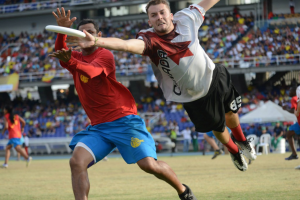
In 2013, as a founding partner, the Toronto Ultimate Club presented Canada’s first semi-professional ultimate team, the Toronto Rush, to the American Ultimate Disc League (AUDL). They ended their season undefeated, 18-0, and won the AUDL Championships. In 2014, the Montreal Royal joined the league. In 2015, AUDL added the Ottawa Outlaws.
Ultimate has become one of today’s fastest-growing sports. In 2015, the International Olympic Committee (IOC) granted full recognition to the World Flying Disc Federation (WFDF) for flying disc sports, including ultimate. It is widely believed that ultimate will become as popular as soccer, for many of the same reasons soccer is the world’s most popular sport.
Origin of Spirit of the Game.
“An ultimate game has many moments to be won or lost. The final score at the end of the game is only one of those moments.”
The Original Ultimate Rules, authored by Joel Silver and his CHS classmates, do not mention the Spirit of the Game; however, they do specify the official use of referees
In a video interview with Willie Herndon, Joel Silver attempts to define the Spirit of the Game, but it becomes apparent that he is unsure where it came from or what it means. It is important to note that SOTG did not originate at Columbia High School and was not mentioned in their official rules. The first set of official rules did allow for the use of referees. Students who played ultimate at CHS were not athletes or members of the counterculture. With a limited perspective on sports competitions, referees were naturally included in their rules.
In the early days of CHS ultimate games played in parking lots, and referees were not necessary for the same reason that kids playing sports in the park or on the streets did not use referees – they simply did not require them. Technical issues and aggressive play were not a concern during those early student games. In early ultimate games, referees officiated the first collegiate game between Rutgers University and Princeton University. SOTG and offense self-officiating came later.
“SOTG is not a hard and fast rule with penalties for non-compliance. It’s a playing philosophy and personal commitment by a player to present and expect a spirit of honesty and respect every time they take to the field.”
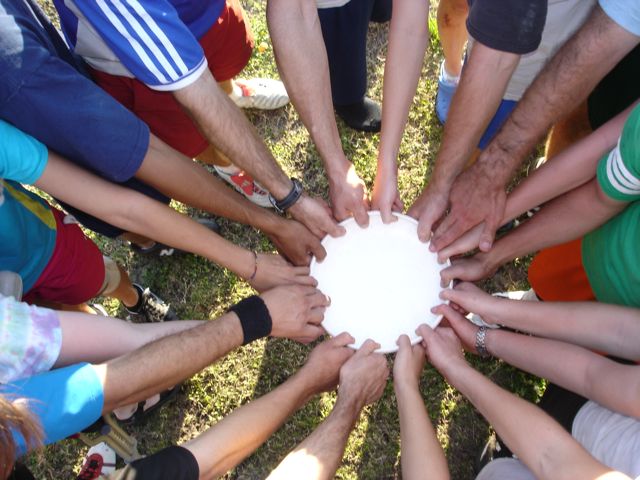 In the early days of Frisbee play and the beginning of disc sports, the community of the first disc athletes considered themselves to be members of a Frisbee Family. In the 1970s, the Spirit of the Game was present but not yet recognized. It reflected the alternative attitude of early disc athletes towards traditional sports more than the game itself.
“Having referees leads to testing the limits, but when it comes to matters of one’s honor, it becomes a different story.”
The Spirit of the Game emerged organically as a way for early players to compete in these newly structured disc sports. Originating from the counterculture and all disc sports, the Spirit of the Game emphasizes integrity, honesty, and respect. These values apply not only to athletes in the sport but also reflect the character qualities one chooses to embody as a person.
“Every play you make, every call you initiate or counter, showcases your integrity and character as a player and an individual. Regardless of its immediate significance or your desire for it to benefit your team, your actions are observed by all those present. These moments are how you will be judged and remembered by others as to how you played the game, and when under moments of intense game pressure, you measured up.”
Spirit of the Game, philosophically in competitive play for years, and not appearing to end anytime soon, was officially recognized, named, and defined for the first time, and written into the 1978 Official Rules for Ultimate. History of Ultimate
Timeline of National Ultimate Developments in Canada.
From the 1960s to the early 1970s, ultimate-like flying disc games called frisbee football were played in North America by ball-minded athletes.
1972- Disc sports began in Canada at the Canadian Open Frisbee Championships, Toronto, ON.
1974- Disc sports began on the West Coast at the Vancouver Open Frisbee Championships, Vancouver, BC.
1975- Ultimate is introduced at the four multi-event tournaments. Octad, AFDO, WFC, and the Canadian Open Frisbee Championships on the Toronto Islands.
1977- Ultimate is included in the NAS Vancouver Open Frisbee Championships in Stanley Park.
1978- Discraft began manufacturing the Sport Disc in London, Ontario.
1979–The Toronto Ultimate Club is formed. One of the two oldest continuous leagues in ultimate.
1986– Vancouver and Ottawa, Ultimate Leagues are formed.
1987– Canadian Ultimate Championships, Ottawa. Toronto Darkside wins.
1987– The Winnipeg Ultimate League is formed.
1988– The Manitoba Organization of Disc Sports (MODS), the first Provincial Sports Organization.
1989– Women’s Division added to Ultimate Nationals (CUC).
1991– WFDF World Ultimate Club Championships in Toronto.
1993– The Canadian Ultimate Players Association begins.
1994– Juniors Division added to Ultimate Nationals (CUC).
1995– Masters Division added to Ultimate Nationals (CUC). First Annual University National Championships–open & women’s divisions.
1997– WFDF World Ultimate Club Championships in Vancouver
1998– Team Canada Masters won the first Gold Medal for Canada at Worlds (WUGC)–quickly followed by Gold in Mixed and Open. Since 1998, Canada has been ranked number one in the World, for several years in all divisions, by the WFDF World Ultimate Ranking.
1999 – Mixed Division added to Canadian Ultimate Championships.
2002– Vancouver’s Furious George is the first Canadian team to win the USAU (UPA) Championship.
2004– Calgary Ultimate Association is founded, and league play begins.
2008– WFDF World Ultimate & Guts Championships in Vancouver.
2010– The Canadian Ultimate Players Association changed its name to Ultimate Canada.
2011– Ultimate Canada Hall of Fame honors pioneers and players.
2012– Junior Division at CUC splits from Mixed into Junior Open and Junior Women’s.
2013– The Junior Open and Junior Women’s divisions at CUC split away from the adult events competition, turning CUC into a 7-day tournament.
2013– As a founding partner, the Toronto Ultimate Club presented Canada’s first professional ultimate team, the Toronto Rush, to the American Ultimate Disc League (AUDL). Montreal Royal (2014), Ottawa Outlaws (2015).
2015– WFDF World Ultimate Rankings by Country. Canada is ranked number 2 out of 44 countries. For several years in the 1990s, Canada was ranked number one in all divisions.
2015– The International Olympic Committee (IOC) granted full recognition to the World Flying Disc Federation (WFDF), of which Ultimate Canada is a member, for flying disc sports, including ultimate.
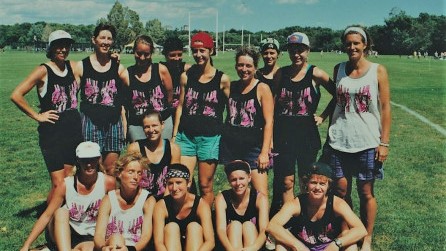
Ultimate Canada Hall of Fame
2011 – Adam “Elvis” Berson | Grant Burns | Jen Catalano | Anja Haman
Steev Limin | Al “Al-Bob” Nichols | Gillian Scarfe | Lorne Beckman | Brian Gisel
John Harris | Scott Lewis | Chris Lowcock | Ken Westerfield | Dean Wright
Marcus Brady | Brian Guthrie | Keith Whyte
2012 – Dante Anderson | Andrew Lugsdin
2013 – Leslie Calder | Jim Brown
2014 – Alex Hughes | Monica Kerr-Coster | Jeff Malmgren
2016 – Cheryl Claibourne | Donnie McPhee
2017 – Jeff Cruickshank | Kirk Savage
2018 – Evan Wood
Ultimate Canada HOF Teams: Furious George (2011), GOO/Prime (2011), See Jane Run (2012), Nomads (2013), Chaos (2014), The Calgary Cynics (2016), Masters of Flying Objects (2017)
- Instruction: Ultimate United
- Directory of Ultimate Frisbee Clubs across Canada.
- Players, organizations, and media sources: Ultimate Canada | USA Ultimate | WFDF | FrisbeeGuru | Ultimate Rob | Ultiworld
Next Articles:
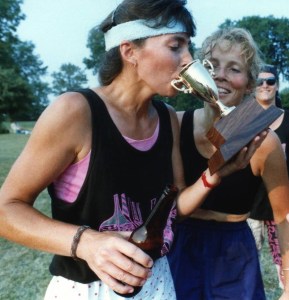
History of Disc Golf in Canada
History of Frisbee and Disc Sports in Canada
Freestyle Frisbee History
Note: This information was referenced and time-lined from disc sport historical and biographical articles, including U.S. and Canadian Disc Sports Hall of Fame inductions, Disc Sports Player Federations, and other historical resources. This article was researched, written, and compiled by historians specializing in Frisbee and disc sports. The history in this document may change as events and people are added.
Reproducing any part of this article, whether in whole or in part, is permitted when proper credit and a link are provided.
© 2026 Disc Sports History. All rights reserved.
 The History of Frisbee and Disc Sports